



Research Spotlight
Humanely deterring birds around aquaculture and development of AI-driven, non-lethal deterrence tactics
Ronnie O. Serfa Juan1, Alison R. Gerken1, and Joseph E. Gerken2
1USDA-ARS Stored Product Insect and Engineering Research, Manhattan, Kansas
2Department of Horticulture and Natural Resources, Kansas State University, Manhattan, Kansas
Ronnie O. Serfa Juan, a SCINet/AI-COE Fellow with the USDA Agricultural Research Service (ARS), works under the mentorship of Dr. Alison R. Gerken at ARS’s Center for Grain and Animal Health Research in Manhattan, KS. Initially, Dr. Serfa Juan’s SCINet-supported research focused on AI-powered insect infestation detection for stored grain products using computer vision and embedded electronics to improve post-harvest monitoring. Building on that expertise—and following a key suggestion from Dr. Joseph Gerken at Kansas State University—the team realized that similar AI computer vision methods could address a different challenge: protecting aquaculture from predatory birds without harming wildlife.
Predatory birds such as Great Blue Herons, Canada Geese, and Egrets can cause significant losses at fish ponds. Traditional deterrents like netting and noise cannons are often intrusive or ineffective over time. The project leverages SCINet’s high-performance computing (HPC) resources to train and optimize YOLO-based deep-learning models using large datasets of bird images. (“YOLO”, which stands for “you only look once”, is a family of deep-learning computer vision models.) These trained models make it possible to implement detection and identification of birds in real time at aquaculture ponds in the field.
The system integrates a rotating motion detection sensor for rapid movement recognition with an AI-enabled camera system for species identification. Once a bird is detected, a controller activates a water-misting device to safely deter the bird without harm (Figure 1). The SCINet infrastructure-trained models—optimized for fast image processing—enable reliable performance even in remote ponds with limited connectivity. This pipeline ensures a sustainable, non-lethal deterrent that protects fish stocks while preserving biodiversity.
Ronnie works closely with Dr. Alison R. Gerken (USDA-ARS), whose mentorship and behavioral ecology expertise shaped species-specific detection zones, misting duration, and deployment strategies to align the technology with natural bird responses. Dr. Joseph Gerken and his team (Kansas State University) contributed field expertise on aquatic ecosystems and environmental data analysis, ensuring ecological sensitivity and real-world feasibility. Their interdisciplinary synergy across AI, behavioral biology, and aquaculture ensures that the project’s design is both technically rigorous and environmentally ethical.
Dr. Serfa Juan has been awarded the 2025 Christine Stevens Wildlife Award from the Animal Welfare Institute (AWI) for this research project. The prestigious award—listed among AWI’s Christine Stevens Wildlife Award winners, —recognizes research that promotes humane, non-invasive solutions to wildlife conflicts. The project was selected for its creative and ethical approach to balancing animal welfare and aquaculture protection.
The team plans expanded field trials and refinements to improve detection performance under diverse environmental conditions, while engaging stakeholders in agriculture, and wildlife conservation. By combining SCINet HPC resources, AI computer vision technology, and embedded electronics, this project represents how USDA researchers are advancing adaptive, humane solutions for wildlife conflicts in agriculture.
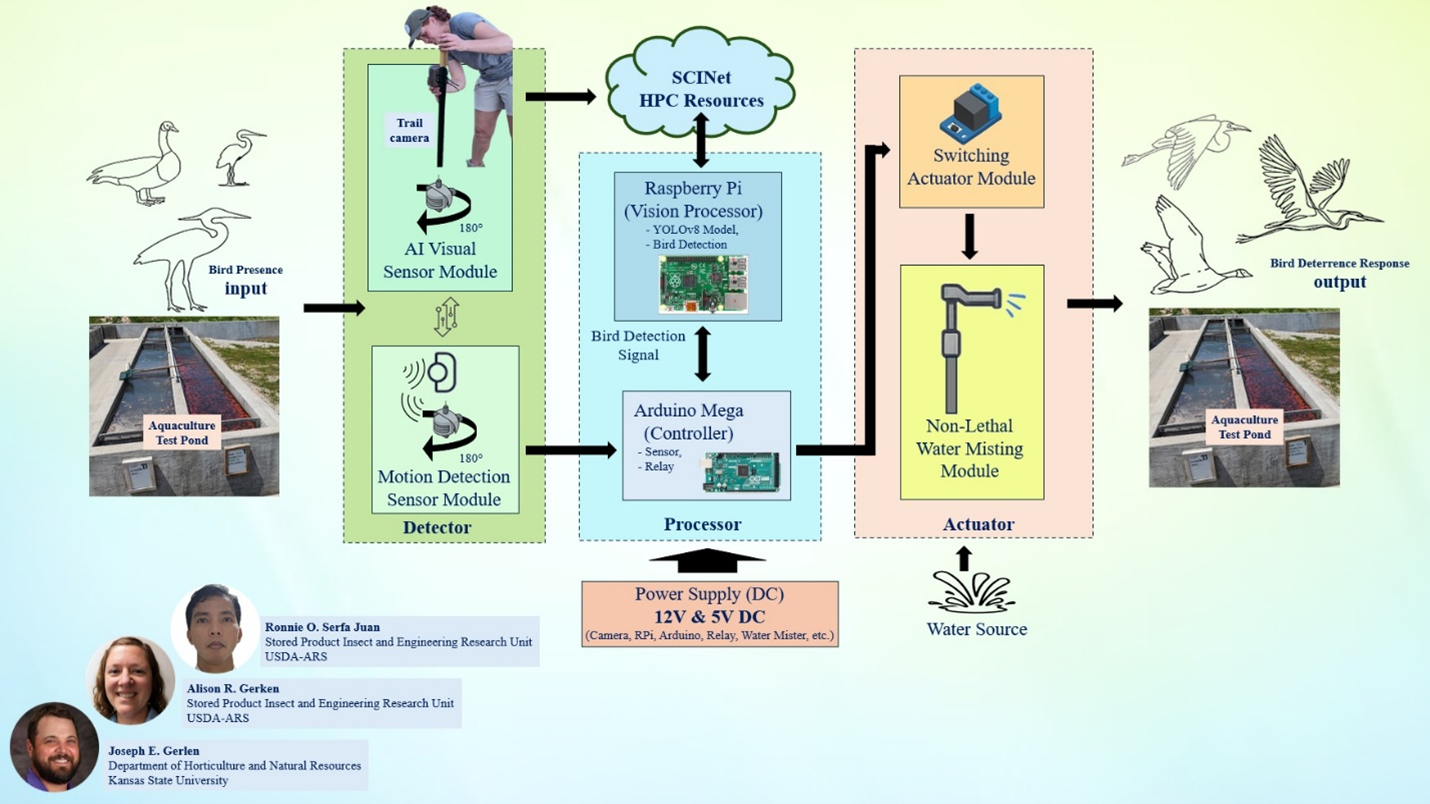 Figure 1. Block diagram of the AI-driven bird deterrence system integrating SCINet HPC resources for YOLO-based model training, edge deployment on embedded hardware, and non-lethal water misting to protect aquaculture ponds.
SCINet and AI-COE Fellows
Please welcome our newest SCINet and ARS Artificial Intelligence Center of Excellence (AI-COE) fellow!
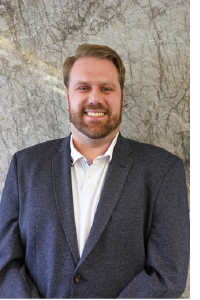
Dr. John Konvalina is a SCINet/AI-COE fellow under the mentorship of Dr. Jason Abernathy (USDA-ARS, Auburn, AL). Dr. Konvalina earned his B.S. in Biology and Fisheries & Wildlife at the University of Nebraska-Lincoln, his M.S. in Biology at Arkansas State University, and his Ph.D. at the University of Central Florida. His previous research focused on snake reproductive biology, alligator population genomics, and adaptation to salinity in freshwater species. Immediately prior to coming to Auburn, he completed an ORISE USDA-ARS postdoctoral appointment focused on creating a pan-genome annotation for rainbow trout.
As a SCINet/AI-COE fellow, Dr. Konvalina will continue to contribute to aquaculture research by using machine learning models to identify the epigenetic factors that impact reproductive success in catfish.
News
Last chance! Apply Now to Serve as an AI-COE/SCINet Graduate Student Internship Mentor in 2026!
As recently announced through Area offices, we are accepting applications to serve as an ARS AI-COE/SCINet graduate student internship mentor in 2026! These internships allow graduate students with strong data science and computational skills to spend either a summer or a semester working full time with an ARS mentor (or mentors) on an ARS research project. Please note that ARS mentors are not required to have specific data science or computing expertise! Rather, their role is to guide the scientific direction of the project and to contribute the intern’s professional development.
Each 10-week internship includes a competitive stipend and travel funding for the participant to spend time onsite with their ARS mentor(s). We are working with three partner universities to recruit student participants. We want each of our interns to have an outstanding experience, which means we need outstanding ARS mentors and research projects!
If you are interested in participating, please visit the mentor application page for more information about how to prepare and submit your application.
Applications are due by end of day Monday, December 8, 2025.
FY26 SCINet/AI-COE Postdoctoral Fellowships call for proposals
SCINet and the ARS AI-COE are again offering postdoctoral fellowship funding to ARS scientists who wish to mentor SCINet/AI-COE fellows working in their labs. These fellowships provide an exciting opportunity for participants to advance agricultural research by developing and applying new and emerging scientific computing technologies, including big data analytics, artificial intelligence, and machine learning. Fellows will be able to conduct research in collaboration with ARS scientists, use SCINet’s high-performance computing clusters and other computational resources, and access the numerous training opportunities available through SCINet and the AI-COE.
For information and to submit a proposal, please visit the proposal application page.
The deadline for applications is COB on Friday, February 6, 2026.
FY26 AI Innovation Fund Awards call for proposals
The ARS AI-COE is again sponsoring AI Innovation Fund awards to support research projects that apply AI and machine learning (ML) methods to agricultural research or that develop new software tools or data products that use AI or ML techniques. We expect to fund 4 to 6 projects of up to $100,000 each. Funds will need to be spent this fiscal year, so projects should have a short budget timeline or involve partnerships that can be funded through collaborative agreements.
Please visit the AI Innovation Fund page for more information and for application instructions.
The deadline for applications is COB on Friday, February 6, 2026.
More flexible GPU limits
It has been exciting to see the many innovative ways that ARS researchers are using SCINet’s graphics processing units (GPUs), and as GPU use has expanded, we’ve been working to ensure that the GPU limits in Slurm satisfy as many use cases as possible. We’ve recently heard feedback from users that more flexibility in allocating GPU resources, including being able to request more GPUs or longer time limits, would be helpful. Over the last few months, we’ve implemented two key changes to help accommodate these needs.
First, it is now possible to request as many as 24 of the NVIDIA L40S GPUs at once (the previous limit was 12). For compute-intensive jobs that can leverage multiple GPUs, this should offer a substantial increase in throughput.
Second, it is now possible to request time limits as long as 7 days for the NVIDIA A100 GPUs. To help preserve resource sharing, we’ve implemented this change so that longer time limits are constrained to have fewer GPUs and CPUs (and vice versa). Specifically, resource limits on the A100 partition (“gpu-a100”) are as follows:
| Requested time limit (days) | Maximum GPU count | Maximum CPU count |
|---|---|---|
|
1 or less |
12 |
192 |
|
2 |
6 |
96 |
|
3 |
4 |
64 |
|
4 |
3 |
48 |
|
5 |
2 |
38 |
|
6 |
2 |
32 |
|
7 |
1 |
27 |
In all cases, no more than 1.5 TB of memory can be requested for a job on the gpu-a100 partition. Previously, the maximum time limit for any GPU job was 2 days. If this approach works well, we may expand it to other GPU partitions in the future. (For an overview of GPU resources on SCINet, please see the user tip, below!)
GPU survey: Help guide GPU upgrades in FY2026!
Demand for graphics processing units on SCINet has grown dramatically in the past few years. To stay ahead of this trend and be prepared for future demand, we are planning our next round of GPU upgrades, and we would value your input to help guide our decision making!
If you would like to contribute, please complete our brief GPU needs survey by COB on Friday, December 12.
Using Globus to share data with external collaborators
Do you have large files on SCINet systems that you would like to share with external collaborators who don’t have SCINet accounts? You will soon be able to do this by using Globus, the same web-based interface recommended for other data transfers to, from, and among SCINet systems!
We will be hosting a webinar Friday, January 23, 2026, 3-4 PM ET to give an overview of what kinds of sharing are supported and a demonstration of how to request and set up file sharing.
Register using this form to receive updates and the call-in information.
Resuming automatic 90-day temporary file deletion
Both of SCINet’s supercomputers (Ceres and Atlas) provide temporary storage space at /90daydata, and files in /90daydata are usually automatically deleted after 90 days of inactivity (please see our Storage Guide for more information). During the lapse in government funding, automatic deletion of temporary files was disabled.
Please note that we plan to resume automatic temporary file deletion on January 2, 2026. If you have any files in /90daydata that will be older than 90 days on January 2 which you intend to keep, please move them to another storage location before that date.
DTU Health Tech applications supported on SCINet clusters
Applications developed and published by DTU Health Tech are now supported on SCINet clusters. Since the applications require users to accept terms of use, SCINet users first need to submit a short form to accept the terms and request access to the software. Currently, the DTU Health Tech application installed is SignalP – 6.0h. If there are other applications from DTU Health Tech you wish to have available on SCINet clusters, please fill out this software request form.
SCINet Working Groups
SCINet working groups (WGs) support ARS researchers and their collaborators in using scientific computing methods and SCINet computational resources in their research. Common WG activities include hosting recurring virtual meetings and webinars, organizing training events, and participating in collaborative research or software development projects.
Current Working Groups
- Ag100Pest Initiative (subgroup of AGR)
- Animal Behaviour AI Working Group
- Arthropod Genomics Research (AGR) Working Group
- Breeding AI and ML Working Group
- Geospatial Research Working Group
- Microbiome Working Group
- SCINet-Longterm Agroecosystem Research (LTAR) Phenology Working Group
- Protein Function and Phenotype Prediction Working Group
- Translational Omics Working Group
If you are interested in creating a working group, please compile the following:
- The working group’s name
- A description of the working group including its purpose and goals
- Contact information for people to reach out to if they want to learn more about or join the working group.
Send this information to the SCINet office at ARS-SCINet-Office@usda.gov.
Training
Training workshops
RNA-seq analysis with Galaxy
Rescheduled to January 26 & 28, 2026, 1-5 PM ET
Leads: Genome Informatics Facility at Iowa State University and SCINet Office
In this workshop participants will work through a complete RNA-seq analysis using Galaxy. Participants will learn how to create workflows in Galaxy to:
- Upload and process RNA-seq data
- Perform quality control, alignment and expression quantification
- Identify differentially expressed genes using DESeq2
We will also explore ways in which you can share your history and workflows with others in Galaxy and how it can be a powerful tool for collaborations.
At this time, registration is closed as we have reached maximum capacity for the workshop. However, you may complete the registration form to be added to our waitlist for future offerings.
Carpentries: Unix, Git, and Python
Rescheduled to February 3 & 5; February 11 & 13, 2026, 1-5 PM ET
Leads: Keo Corak (ARS Computational Biologist), Amisha Poret-Peterson (ARS Research Microbiologist), and Steven Schroeder (ARS Computational Biologist)
The SCINet Office, in collaboration with ARS’s certified Carpentries instructors, is offering a Carpentries workshop that will teach participants the Unix command line, version control with Git, and Python programming. The workshop will span two weeks:
- Unix command line and version control with Git: Feb 3 & 5, 2026, 1-5 PM ET
- Programming with Python: Feb 11 & 13, 2026, 1-5 PM ET
This workshop will provide an interactive, hands-on experience that will help you learn valuable skills for data management and analysis.
At this time, registration is closed as we have reached maximum capacity for all workshops. However, you may complete the registration form to be added to our waitlist for future offerings.
Using large language models (LLMs) on SCINet’s supercomputers
February 18 & 20, 2026, 1-4 PM ET
Leads: SCINet Office
Large language models (LLMs), a key technology behind well-known tools like ChatGPT and Microsoft Copilot, have a multitude of applications in agricultural research. SCINet’s high-performance computing resources provide an excellent environment for research use of LLMs, and this workshop will equip you with the knowledge and tools you need to take advantage of LLM capabilities in your research.
We will explore a variety of use cases, from basic “chat” interactions to more advanced applications, including information retrieval and summarization and high-throughput automation. Along the way, we will learn about how LLMs and related technologies actually work, which will help you make well-informed decisions about how to best use them for your research.
Ultimately, this workshop will put you in the driver’s seat: you will be able to decide which models are most appropriate and how to use them, all while ensuring that you remain in full control of your data and results and in compliance with research security requirements.
To register, please fill out this registration form.
Transfer learning
February 24 & 26, 2026, 1-5 PM ET
Leads: Research Computing team at the University of Florida
This workshop provides the foundational concepts and practical applications of transfer learning, a powerful technique in deep learning that allows AI models to leverage pre-trained knowledge to improve performance on new tasks. The sessions will cover different types of transfer learning techniques, such as feature extraction and fine-tuning. This includes hands-on experience in applying these techniques to computer vision and language models.
To register, please fill out this registration form.
The Carpentries instructor training
SCINet is collaborating with The Carpentries to offer The Carpentries’ Instructor Training Course for ARS scientists. In this course, you will learn about evidence-based practices for effective and inclusive teaching, with a particular focus on teaching computational skills. There is no fee charged to course participants, but seats are limited.
If you are interested in becoming a Carpentries-certified instructor, please complete this form.
Coursera
The SCINet Office and the AI-COE are excited to provide training opportunities through Coursera. Coursera licenses are available to ARS scientists and support staff for training focused on scientific computing, data science, artificial intelligence, and related topics. Successful completion of courses and specializations result in widely recognized certificates and credentials.
Please visit the SCINet Coursera Training Page to request a license. Licenses will be assigned on a rolling basis and are active for three months. Users may be able to extend their licenses upon request.
Workshop Reports
Practicum AI workshop series
Leads: Research Computing team at the University of Florida
The Practicum AI series offered in collaboration with the Research Computing team at the University of Florida is a hands-on, applied artificial intelligence curriculum intended for learners with limited coding and math background. This series consisted of 3 workshops (for a detailed summary, please click on the workshops of interest):
- Computing for AI: August 19, 2025, 2-5 PM ET
- Python for AI: August 27 & 28, 2025, 2-5 PM ET
- Deep Learning Foundations: September 3 & 4, 2025, 2-5 PM ET
In these workshops, participants gained hands-on experiences in basic computing skills for AI/ML, neural networks, deep learning for image tasks and image classification and Natural Language Processing using pre-trained models. We will also be offering an intermediate course in the Practicum AI series, Transfer learning, in February. To register, please complete this form.
Please help us improve our training offerings!
What scientific computing training do you need? The SCINet Office’s goal is to provide training opportunities and resources that meet the needs of ARS researchers, so we would be grateful if you could complete our short training request form and let us know how we can best help you learn the computing skills you need. Your feedback will help us decide where we should focus our efforts over the next year and beyond.
Training opportunities are continually being updated on the SCINet Upcoming Events webpage. For more information on any of the above trainings, registration questions, or suggestions, please email SCINet-training@usda.gov.
Support
Getting Started with SCINet is as easy as 1,2,3
If you do not already have a SCINet account, we hope you will consider joining the 2,300+ researchers who do. Follow the steps below to get started with SCINet.

- Request a SCINet account to gain access to computational and training resources.
- Read the SCINet FAQs covering helpful topics such as account management, accessing and installing software, obtaining storage space for your project(s), and how to get technical help.
- Visit the SCINet Forum to connect to other users, ask questions, and learn how SCINet can enable your research. P.S. Don’t forget to complete your annual USDA information security awareness training! This is required to maintain your account. For technical assistance with your SCINet account, please email scinet_vrsc@usda.gov.
Support email addresses
All requests for help with user accounts, login problems, resource requests, or support for the Ceres HPC cluster should be sent to the SCINet Virtual Research Support Core (VRSC) at scinet_vrsc@usda.gov. Help requests specific to the Atlas HPC cluster should be sent to help-usda@hpc.msstate.edu.
Many emails are currently being sent to other SCINet email inboxes. For the most expedient response to your support requests, be sure to send them to scinet_vrsc@usda.gov or to help-usda@hpc.msstate.edu for Atlas-specific requests.
SCINet User Tip
GPU resources available on SCINet
Graphics processing units (GPUs) are increasingly essential for a wide range of scientific computing tasks, including many deep learning applications. SCINet currently provides a variety of GPUs on the Atlas supercomputer (Ceres does not have GPUs). These GPUs are available to all SCINet users, so whether you are experienced with GPU computing or just getting started, we encourage you to try them out! The following table summarizes all GPU resources currently available on Atlas.
| GPU type | GPU memory | Slurm partition | Number of GPUs available |
|---|---|---|---|
|
NVIDIA V100 |
32 GB |
gpu-v100 |
8 |
|
NVIDIA A100 |
80 GB |
gpu-a100 |
24 |
|
NVIDIA A100, multi-instance |
10 GB |
gpu-a100-mig7 |
112 |
|
NVIDIA L40S |
48 GB |
gpu-l40s |
48 |
To use any of these GPUs, you will need to request the appropriate resources from Slurm, including enough CPUs and “regular” memory to support your GPU application. You will also need to specify the appropriate participation and indicate that you want to use at least one GPU using Slurm’s --gres argument. For example, Slurm sbatch arguments to request one L40S GPU, 16 CPUs, and 32 GB of memory would look like this:
#SBATCH --partition=gpu-l40s
#SBATCH --gres=gpu:1
#SBATCH --ntasks=16
#SBATCH --memory=32GB
Please note that unless the software you are using is specifically designed to use more than one GPU, we recommend only requesting one GPU at a time. In many cases, requesting multiple GPUs will not result in faster performance and will merely take resources from other SCINet users. For more information, please see Atlas’s documentation.
Do you have tips to share? Email them to ARS-SCINet-Office@usda.gov to be included in future newsletters.
SCINet Corner
SCINet Corner is a VRSC-moderated virtual space for people to share knowledge, discuss best practices, learn about new opportunities, and explore resources to support progress on their projects.
The next SCINet Corner will be held on January 22, 2026, from 1-2 PM ET. January’s event will give an overview of SCINet and the computing and training resources we offer.
You can register for this and future SCINet Corners here.
Have a question that just can’t wait? Want to see what other users are doing? Reach out to the ever-expanding SCINet Forum community for ideas, support, or just someone to bounce ideas off of at https://forum.scinet.usda.gov/.
Connect
The SCINet Community
To see all the SCINet community updates and review past newsletters, visit the Newsletter Archive.
Contribute
Do you use SCINet for your research? We would love to share your story! Email ARS-SCINet-Office@usda.gov to contribute content, ask questions, or provide feedback on the SCINet newsletter or website.
SCINet Office
Haitao Huang, Computational Biologist
Moe Richert, Web Developer
Lavida Rogers, Training Coordinator
Heather Savoy, Computational Biologist
Brian Stucky, Computational Biologist, Acting Chief Scientific Information Officer
SCINet Leadership Team
Brian Stucky, Acting Chief Scientific Information Officer
Rob Butler, SCINet Program Manager
Jeremy Edwards, Science Advisory Committee (SAC) Chair
Jeff Silverstein, Associate Administrator